

25 Sinking Fund Ideas That Help You Save Money Faster
Here’s something worth sitting with for a second: most of the expenses that blindside people every year aren’t actually surprises. Car registration comes due the same month every year. Holiday gifts happen every December, like clockwork.
Your insurance premium doesn’t just show up out of nowhere. And yet, somehow, these predictable costs still get treated as emergencies when they land.
That’s exactly the gap sinking funds are built to close. A sinking fund Ideas are just money you set aside a little at a time, ahead of an expense you already know is coming.
I’ve spent a good chunk of my career picking apart budgeting methods, and sinking funds are honestly one of the most underrated tools out there for staying out of debt without white-knuckling every purchase.
This guide covers what sinking funds actually are, how to set one up without overcomplicating it, and 25 categories you can start using this week.
What a Sinking Fund Ideas Actually Is
Think of it as the opposite of an emergency fund. An emergency fund exists for the stuff you can’t see coming — a layoff, a burst pipe, a surprise medical bill.
A sinking fund is for the stuff you absolutely can see coming, even if you’re a little fuzzy on the exact date or dollar amount. Holiday gifts. Car repairs. That annual premium that always seems to catch you off guard even though it happens every single year.
The logic is dead simple. Instead of getting hit with a $600 repair bill or a $400 holiday shopping tab all at once and scrambling to cover it, you chip away at it in smaller pieces every month, so by the time the bill shows up, the money’s already sitting there waiting.
Why This Actually Matters
Years of looking at how people save (or don’t) has taught me one thing: “surprise” expenses are rarely surprises at all. Property taxes, car registration, holiday spending — these happen every year, on a schedule, and yet plenty of households still react to them like a fire drill.
Sinking funds take that panic out of the equation. Instead of reaching for a credit card the moment the bill lands, you’ve already budgeted for it. It’s sitting there, quietly waiting, fully accounted for.
The Upside and the Catch
What works in their favor:
- They keep debt from piling up around expenses you could’ve seen coming
- They take a lot of the anxiety out of annual or seasonal costs
- Breaking a big number into small monthly chunks makes it feel manageable instead of scary
- Your actual emergency fund stays untouched for actual emergencies
- They push you toward planning ahead instead of scrambling after the fact
What they’ll cost you in effort:
- Managing several at once takes some ongoing attention
- Without a clear system, it’s easy for things to get messy fast
- You need to sit down and actually estimate costs, which takes a bit of upfront work
Who Gets the Most Out of This
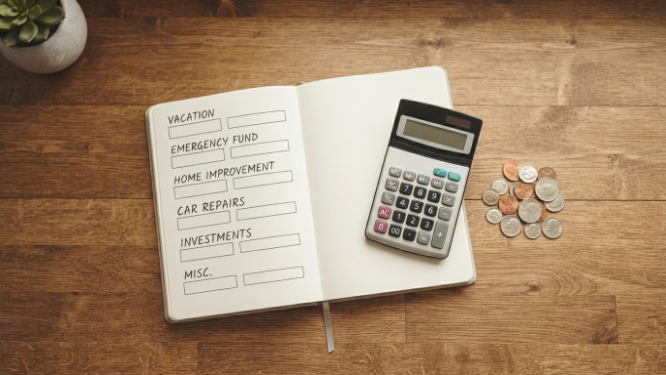
Sinking funds tend to click especially well for:
- Households that deal with the same predictable annual or seasonal costs every year
- Anyone who’s leaned on credit cards to survive the holidays more than once
- Homeowners bracing for maintenance or repair costs down the line
- Car owners trying to stay ahead of registration, maintenance, or repairs
- Couples or families saving together for something specific — a vacation, a renovation, whatever it is
Setting One Up, Step by Step
1. Figure out what’s coming. Look back over the last 12 months and flag anything that wasn’t a monthly bill but still showed up — car repairs, gifts, annual fees, all of it.
2. Put a real number on it. Pull up old bills or do a quick search for current pricing. Don’t just guess.
3. Pick a target date. When’s this expense actually going to hit? Also read How to Build an Emergency Fund Using an Emergency Fund Calculator.
4. Do the math on your monthly contribution. Total cost divided by the number of months until you need it. That’s your number.
5. Give it a home. A high-yield savings account with labeled sub-accounts works well — most banking apps make this easy now.
6. Automate it. Set up a recurring transfer so you’re not relying on remembering to do this manually every month.
7. Revisit it now and then. Prices change. Your estimates should too.
25 Sinking Fund Ideas Worth Starting
- Holiday gifts and celebrations
- Car maintenance and repairs
- Car registration and licensing fees
- Annual insurance premiums
- Home maintenance and repairs
- Property taxes
- Vacation and travel
- Back-to-school supplies
- Birthday gifts and parties
- Wedding-related expenses
- Pet care and veterinary bills
- Medical and dental co-pays
- Home appliance replacement
- Furniture and home decor
- Annual subscriptions or memberships
- Tech upgrades (phone, laptop)
- Clothing and seasonal wardrobe updates
- Holiday travel expenses
- Charitable giving and donations
- Professional development or certifications
- Wedding or event attendance costs
- Annual conference or work-related travel
- Home cleaning or moving expenses
- Emergency car rental or transportation
- New baby or childcare-related expenses
A Real Example: Breaking the Holiday Debt Cycle
Picture a couple who, every December, put holiday spending on a credit card and then spent the next few months quietly paying it off with interest tacked on. Same pattern, year after year.
Once they discovered sinking funds, they sat down, looked at their spending history, and found they averaged about $1,200 a year on holiday costs. So they opened a dedicated fund and started automating $100 a month starting in January.
By the time the holidays rolled around, the money was already there. No new debt. First time in years. That win gave them enough confidence to add a couple more funds — one for car maintenance, one for their annual family trip.
What this really comes down to is a mindset shift: swapping last-minute, reactive spending for small, steady contributions made well ahead of time.
Where People Trip Up

- Lowballing the cost estimate. Look up real numbers instead of guessing, especially for the bigger expenses.
- Dumping everything into one unlabeled account. It’s nearly impossible to track what’s meant for what if it’s all mixed together.
- Skipping automation. Manual transfers are the first thing to slip during a busy month.
- Never revisiting the numbers. Prices creep up. Your estimates need to keep pace.
- Raiding a fund for something it wasn’t meant for. Each one has a job. Let it do that job.
Sinking Funds vs. Emergency Funds
| Feature | Sinking Fund | Emergency Fund |
| Purpose | Planned, predictable expenses | Unexpected expenses or income loss |
| Timing | Known or estimated in advance | Unknown |
| Number of Accounts | Often several, one per goal | Usually just one |
| Contribution Style | Fixed amount toward a specific goal | Ongoing until fully funded |
What Actually Makes This Sustainable
If there’s one pattern I keep seeing among people who manage several sinking funds well, it’s this: they almost always use labeled sub-accounts instead of tossing everything into one general savings pool. A few other things that help:
- Use a banking app that lets you create multiple named sub-accounts under one high-yield savings account
- Take a look at your whole list once a year — priorities shift, and your funds should shift with them
- Start with whichever fund is most likely to push you into debt if it goes unplanned — usually car maintenance or holiday spending
- Keep these completely separate from your emergency fund so the two never get muddled
- Got a bonus or tax refund? Toss some extra into a fund instead of letting it disappear into general spending
Quick Checklist
- Recurring or seasonal expenses from the last 12 months listed
- Cost and target date estimated for each one
- Monthly contribution calculated
- Labeled sub-accounts or separate savings accounts opened
- Monthly transfers automated
- Sinking funds reviewed and adjusted once a year
Final Thoughts About Sinking Fund Ideas
Sinking funds take expenses that feel like emergencies and turn them into just… line items. Nothing dramatic.
After digging into more personal finance strategies than I can count, I keep landing on the same conclusion: even two or three well-planned sinking funds can meaningfully cut down how often you reach for a credit card, and make the whole budget feel less like a tightrope walk.
Pick the one or two categories that tend to catch you off guard the most, and start there. Also read Investment basics explained simply for non financial people.
Frequently Asked Questions
1. What is a sinking fund?
Money you set aside a little at a time for a specific expense you know is coming — holiday gifts, car maintenance, that kind of thing.
2. How’s this different from an emergency fund?
A sinking fund covers what you can predict. An emergency fund covers what you can’t — job loss, medical emergencies, the truly unexpected stuff.
3. How many sinking funds should I actually have?
Depends on your life, but most households do fine with somewhere between three and six covering their most common recurring costs.
4. Where should the money actually sit?
A high-yield savings account with labeled sub-accounts is a solid choice — you stay organized and still earn a bit of interest.
5. How do I figure out my monthly contribution?
Take the total estimated cost and divide it by however many months you’ve got until you’ll need it.
6. Can this actually help me avoid debt?
Yes — planning ahead for costs you know are coming means you’re not reaching for a credit card when they show up.
7. Which categories should I start with?
Holiday spending, car maintenance, and home repairs are the usual suspects — they tend to cause the most stress when nobody planned for them.
8. Should I keep adjusting my contributions over time?
Definitely. Revisit your numbers every year or so, since costs rise and priorities change.