

What Is Investing for Beginners: Basics You Should Know
Why Investing Is Important for Beginners

A lot of beginners get to hear about investing and do not know where to begin. They usually feel that investing is a hazard, a complex or exclusive activity of rich individuals. Actually, the meaning of investing to amateurs is to learn to make your money work with time with the appropriate strategy. The guide provides a summary of the fundamentals of investing, its importance, and simple steps that a beginner can take to invest without having to worry.
Investing Basics for Dummies
Fundamentally investing involves an act of investing in assets in anticipation that they will yield a profit in the future. Rather than holding money that does not produce any profit, investing will enable it to increase in terms of appreciation, interest, or income. Investment among beginners is long-term growth and not fast money. The basic concept is simple. You spend money today in order to be able to earn more tomorrow. In the long run, this will make you achieve income targets such as home purchase, education, or even retirement.
The Importance of Investing for Beginners

Reduced purchasing power may not be effectively achieved by saving money only, since inflation causes a decline in purchasing power. Money in a savings account may be losing its value over time. Investing will make your money keep pace with or higher than inflation. Financial discipline is also developed when investors are beginners. Compounding is a process that can work in your favor even when you have small amounts that you can invest regularly.
Typical Investing Issues Starting Investors Experience
Fear of loss is one of the primary issues. Up and down the market can be a stressful experience for the newcomer. The other issue that is common is a lack of knowledge and, hence, confusion on where and how to invest. Others who are starting do not invest immediately due to the belief that they require a lot of money. Others make emotional moves depending on the immediate market trends, which in most cases result in low performance.
How to Invest: An Easy Guide to Investment
Investment involves the purchase of items that can grow in value. As an example, when you purchase stocks of a company, you have a small share of the business. In the case of company expansion, your investment can be higher. There are normally two types of returns. The increase in capital occurs when the value of the asset increases. Depending on the type of investment, income is received in the form of dividends, interest, or even rental income.
An Investor should be aware of the types of Investments
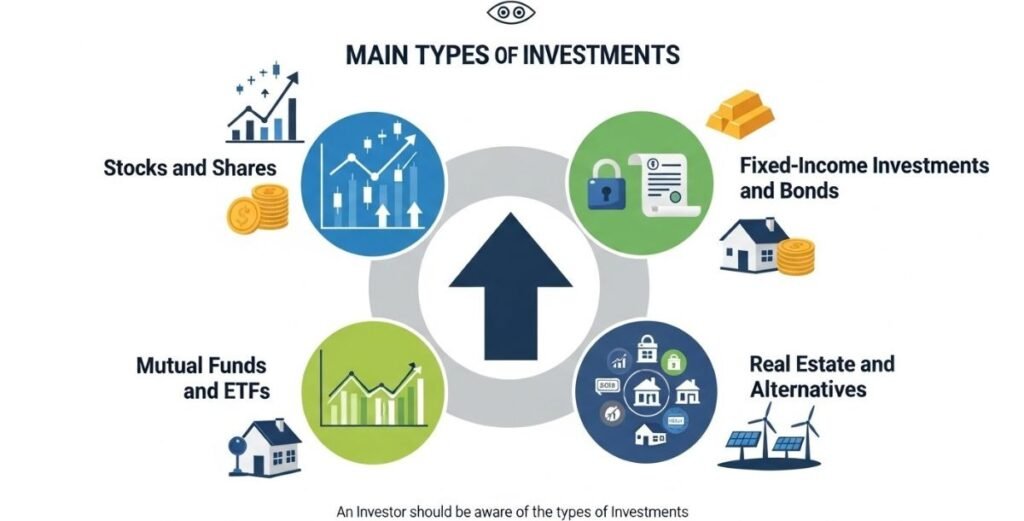
Stocks and Shares
Shares are ownership of firms. They are riskier but have a greater growth potential. Stocks are appropriate for those who are new and have a long-term investment strategy.
Fixed-Income Investments and Bonds
Bonds are loans provided to companies or governments. They tend to offer predictable returns and reduce risk as compared to stocks. Bonds can be used to provide stability to an investment portfolio.
Mutual Funds and ETFs
Both mutual funds and exchange-traded funds pool funds of lots of investors. Their investment is in a combination of assets, hence they are newcomer-friendly and diverse.
How to get started in investing as a beginner
Having your financial objectives first. Determine whether you are making a short-term investment or long term investment. The specific objectives are used to direct your investment decisions.
Second, select a platform of investment. The ease of online brokerage and investment applications allows novices to begin with little. Find websites that have minimal charges and learning material.
Third, begin small and invest on a regular basis. Regular investment can lessen the risk factor, and confidence is earned in the long run.
Resources and Applications to Get Started with Investments
Numerous online platforms provide tools that are aimed at amateurs. Robo-advisors are automated investment managers that work on autopilot according to the level of risk. Investment apps offer investments, data, and automated investments. These investment tools make it easy to invest, and beginners can always remain consistent without having advanced financial knowledge.
The Top Ten Investing Errors Which Amateurs Should NOT Do
Making the mistake of attempting to time the market is one of them. It is not easy to predict short-term movements, and most of the time, it results in losses. Lack of diversification is another error that exposes a person to risk. The novices also, at times, invest without the knowledge of what they are purchasing. It is necessary to learn the fundamentals before investing.
The best practices to follow for a beginner investor
The earlier the better to ensure compounding. Small investments can also be of great value in the long run. Be patient and concentrate on long term objectives rather than short term fluctuations in the market. It is necessary to review regularly your investments, but not to be over-reactive to short-term fluctuations. Constant learning enhances competence and judgement.
Investing in the Digital Age: What Investing Is and How to Participate in It

The next thing is the accessibility of investing that technology has made. Novices are able to invest with small sums on mobile applications and online platforms. Learning is easier with educational material, calculators, and tools. The barriers that characterized traditional investing are eliminated with digital investment, and beginners can begin without the fear of failure and be more flexible.
FAQs
In simple terms, what is investing as an amateur?
It is the purchase of assets with the help of money that can be increased in value.
Are first-time investors risk takers?
Every investment is risky, but it can be mitigated through diversification and long-term investment.
What is the amount of money required by beginners to start investing?
Numerous websites enable novices to begin with a very small sum.
Which investment is the most suitable to start with?
Mutual funds or ETFs should be diversified.
Are first-time investors able to invest without knowledge?
Indeed, some easy-to-use applications and websites enable one to invest with simple learning.
Conclusion
Knowing the basics of investing is the way to go to have a solid financial basis. Money is able to grow through investing, safeguard against inflation, and sustain long-term ambitions. Anyone can start investing because it does not require much time, there are beginner-friendly tools, and because of the mistakes that many investors commit. Make the first step today and learn more, and investigate easy types of investments.