
ETF Investing for Beginners: A Simple Step-by-Step Guide
Quick Answer
ETF investing means buying a single fund that holds a basket of stocks, bonds, or other assets, giving you instant diversification without picking individual companies.
For beginners, a low-cost, broad-market ETF purchased through a brokerage account and held long-term is usually the simplest, most reliable way to start building wealth.
Key Takeaways
- ETFs (exchange-traded funds) let you buy hundreds of companies in one trade
- They typically cost less than mutual funds and trade like stocks
- Beginners should start with broad, low-fee index ETFs before anything specialized
- Consistency matters more than timing the market
- Diversification lowers risk but doesn’t eliminate it
When I first started investing, I remember staring at my brokerage app convinced I needed to pick “the next big stock” to get anywhere. I didn’t.
What actually moved my net worth was something far less exciting: buying a broad ETF every month and leaving it alone. That’s the entire secret behind this guide, and I want to walk you through it the way I wish someone had walked me through it.
What Is an ETF, Really?
An ETF, or exchange-traded fund, is a basket of investments — stocks, bonds, or sometimes commodities — bundled into a single security that trades on a stock exchange just like a regular share. Instead of buying one company’s stock, you’re buying a slice of dozens, hundreds, or even thousands of companies at once.
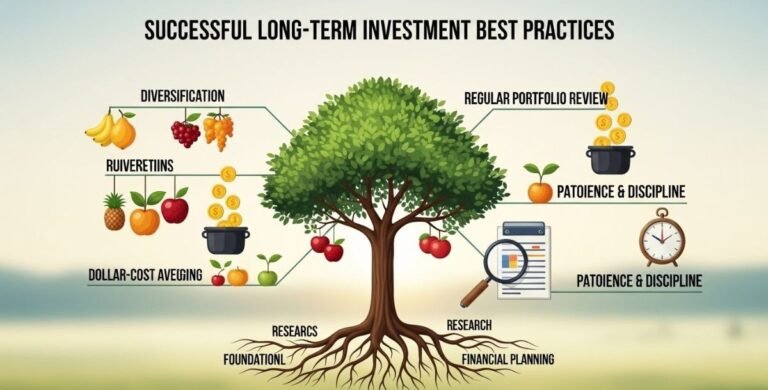
Think of it like a fruit basket instead of a single apple. If one apple goes bad, you’ve still got the rest of the basket. That’s diversification in a nutshell, and it’s one of the core ideas behind long-term investing.
ETFs differ from mutual funds in a few practical ways:
- They trade throughout the day like stocks, rather than pricing once at market close
- They tend to have lower expense ratios
- Many are passively managed, meaning they track an index rather than trying to beat it
Also read Investment basics explained simply for non financial people.
Why Beginners Gravitate Toward ETFs
I’ve helped readers understand personal finance by breaking things down to first principles, and here’s the honest version: most people don’t have the time, data, or emotional discipline to pick individual winning stocks consistently. ETFs solve that problem by spreading your bets.
The Core Benefits
| Benefit | What It Means for You |
| Diversification | Reduces the damage from any single company underperforming |
| Low cost | Index ETFs often charge under 0.10% annually |
| Liquidity | You can buy or sell during market hours |
| Simplicity | One purchase covers an entire market segment |
| Tax efficiency | ETF structure often creates fewer taxable events than mutual funds |
Types of ETFs You’ll Encounter
Understanding the landscape helps you avoid overcomplicating things early on.
1. Broad Market Index ETFs
These track major indexes and are the backbone of most beginner portfolios. They give you exposure to the overall economy rather than betting on one sector.
2. Sector ETFs
These focus on a specific industry — technology, healthcare, energy. Higher potential reward, but also higher concentration risk.
3. Bond ETFs
These hold government or corporate debt and are generally less volatile, useful for balancing out stock risk as part of your overall asset allocation.
4. Dividend ETFs
These focus on companies with a history of paying shareholders. If you’re interested in passive income, this pairs well with [Related: Dividend Investing for Beginners].
5. International ETFs
These add exposure outside your home country, which can smooth out returns when domestic markets struggle.
Step-by-Step: How to Start Investing in ETFs
Step 1: Open a brokerage account. Most major brokerages now offer commission-free ETF trades and no account minimums.
Step 2: Define your goal and time horizon. Retirement in 30 years looks different from a house down payment in 3 years.
Step 3: Check your risk tolerance. Are you comfortable watching your balance dip 20% in a bad year, knowing it’s temporary? Be honest with yourself here — this determines your asset allocation.
Step 4: Pick one or two broad ETFs to start. You don’t need ten funds on day one. Simplicity beats complexity when you’re learning.
Step 5: Automate your contributions. Set up recurring transfers so investing becomes a habit, not a decision you have to remake every month.
Step 6: Reinvest dividends. This is where compound interest quietly does its best work over decades.
Step 7: Review annually, not daily. Checking your portfolio every day is a fast track to anxiety-driven decisions.
Real-Life Case Study

The Situation: A reader I worked with, a 26-year-old graphic designer, had $4,000 sitting in a savings account earning almost nothing. She was intimidated by investing and worried about “losing everything.”
The Strategy: We started small. She opened a brokerage account, put $2,000 into a broad-market ETF, and set up a $150 automatic monthly contribution. No stock-picking, no day-trading, no complicated spreadsheets.
The Outcome: Eighteen months later, despite two rocky months in the market, her balance had grown steadily because she never stopped contributing and never panic-sold during the dips.
Key Lessons Learned: Consistency outperformed cleverness. She didn’t need to be a market expert — she needed a repeatable system and the patience to let compound interest and dollar-cost averaging do the work.
Expert Tips
- Start with a total market or S&P 500-style ETF before branching into sector bets.
- Compare expense ratios closely — a 0.03% fund versus a 0.75% fund adds up enormously over 30 years.
- Use dollar-cost averaging: invest a fixed amount on a fixed schedule regardless of price.
- Don’t confuse a low share price with a “cheap” fund — look at the expense ratio and holdings, not the sticker price.
- Hold ETFs inside tax-advantaged retirement accounts when possible to defer or avoid taxes.
- Rebalance your allocation once or twice a year, not every time the market moves.
- Avoid chasing last year’s best-performing sector ETF — performance rotates.
- Keep your emergency fund separate from your investing account; never invest money you might need within 12 months.
- Watch out for “leveraged” or “inverse” ETFs — these are trading tools, not long-term holdings, and can erode value quickly.
- Track your overall net worth, not just your portfolio balance, to see the full picture of your financial progress.
Common Mistakes to Avoid
Mistake 1: Checking the account too often. This happens because short-term price swings feel urgent. Avoid it by setting a fixed review schedule — quarterly is plenty for a long-term investor.
Mistake 2: Overdiversifying with overlapping funds. Beginners sometimes buy five ETFs that all hold the same top 20 companies. Check the fund’s actual holdings before buying multiples.
Mistake 3: Panic-selling during downturns. Market drops trigger loss aversion, a well-documented behavioral finance bias. Remind yourself that volatility is the cost of admission for long-term growth.
Mistake 4: Ignoring fees. A 1% annual fee sounds small but compounds into a massive drag on returns over decades.
Mistake 5: Investing money needed soon. Short-term goals belong in savings, not in the market, where a downturn could hit right when you need the cash.
Action Plan
- Open a brokerage account this week if you haven’t already.
- Decide your investing goal and time horizon.
- Choose one broad-market ETF as your foundation.
- Set up an automatic monthly contribution, even if it’s small.
- Reinvest all dividends automatically.
- Review your allocation every 6–12 months.
- Increase contributions as your income grows.
Conclusion
ETF investing isn’t about finding a secret formula — it’s about starting, staying consistent, and letting time do the heavy lifting. One mistake I made early on was waiting for the “right moment” to begin, which cost me months of potential growth.
Don’t make that same mistake. Open an account, pick a solid ETF, automate your contributions, and check back in a year.
Frequently Asked Questions
What is the minimum amount needed to start investing in ETFs? Many brokerages now allow fractional shares, so you can start with as little as $5–$25. The bigger factor is consistency — regular contributions matter more than your starting amount.
Are ETFs safer than individual stocks? ETFs spread risk across many holdings, which generally makes them less volatile than owning a single stock, but they still carry market risk and can lose value.
How do ETFs make money for investors? Investors earn through price appreciation of the underlying holdings and, in many cases, dividend payments distributed by the fund.
What’s the difference between an ETF and a mutual fund? ETFs trade throughout the day like stocks and often have lower fees, while mutual funds price once daily and may carry higher expense ratios.
Can I lose all my money in an ETF? It’s extremely unlikely with a broad-market ETF, since it holds many companies, but sector-specific or leveraged ETFs carry higher risk of significant losses.
How often should I invest in ETFs? A monthly or biweekly automated contribution works well for most beginners and takes advantage of dollar-cost averaging.
Do ETFs pay dividends? Many do, especially those tracking dividend-paying companies or bond markets. These payouts can be reinvested automatically.
What ETF is best for beginners? A low-cost, broad-market index ETF that tracks a major index is typically the most beginner-friendly starting point.
How are ETFs taxed? Gains are generally taxed when you sell, and dividends may be taxable in the year received, unless the ETF is held in a tax-advantaged account.
Is now a good time to start investing in ETFs? Timing the market perfectly is nearly impossible even for professionals; a consistent, long-term approach tends to outperform trying to guess short-term movements.