FIRE Movement Explained: How to Retire Early
Most people plan their finances around one number: the age on their retirement paperwork. The FIRE movement throws that assumption out entirely. Instead of asking “how much do I need by 65,” it asks “how much do I need, period” — and then works backward from there, sometimes shaving decades off the timeline.
If you’ve seen the acronym caround personal finance forums and wondered whether it’s a real strategy or just an internet trend, here’s the honest breakdown: what FIRE actually means, how the math works, and what it takes to pull it off without wrecking your quality of life in the process.
What FIRE Actually Stands For
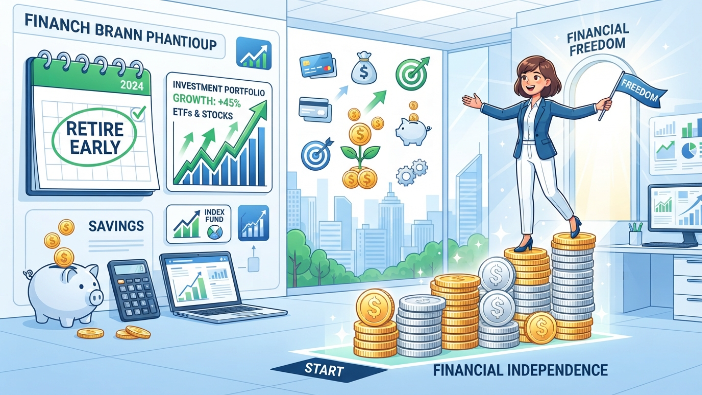
FIRE stands for Financial Independence, Retire Early. The “financial independence” half is the important part — retiring early is really just a byproduct of reaching a point where your investments can cover your living expenses indefinitely. Once that threshold is crossed, working becomes optional rather than necessary.
The concept isn’t new. It borrows heavily from ideas laid out in “Your Money or Your Life” by Vicki Robin and Joe Dominguez back in 1992, which reframed spending as hours of life traded for money.
What changed in the 2010s was the internet: bloggers like Mr. Money Mustache turned that philosophy into a specific, calculable formula, and a community grew up around comparing notes on savings rates and safe withdrawal math.
The Math Behind Financial Independence
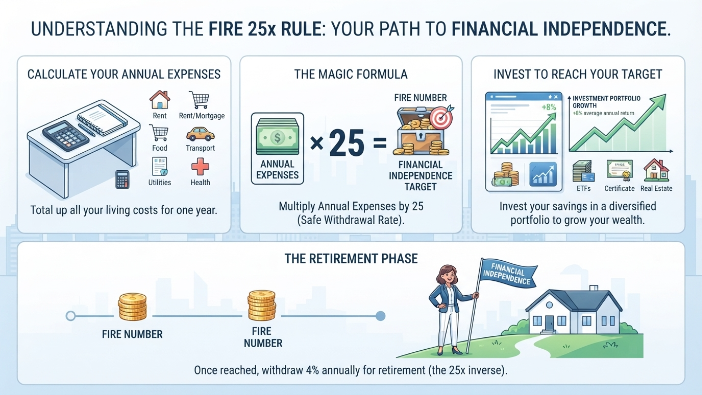
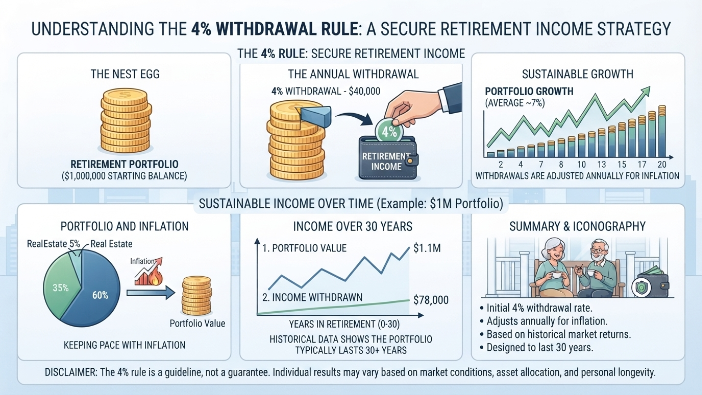
The entire FIRE framework rests on one number: 25 times your annual expenses. This comes from the 4% rule, a guideline built on research into historical market returns (most famously the Trinity Study), which found that withdrawing 4% of a portfolio annually, adjusted for inflation, had a strong track record of lasting 30+ years without running out.
So if you spend $40,000 a year, your FIRE number is $1,000,000. Spend $60,000 a year, and it climbs to $1.5 million. This is why the movement obsesses over reducing expenses as much as increasing income — every dollar you stop spending annually removes $25 from the total you need to save, not just $1.
Some people push the withdrawal rate down to 3.5% or even 3% for extra safety margin, especially if they plan to be retired for 40+ years rather than the standard 30-year window the original research covered.
Others feel comfortable at 4.5% if they have some flexibility to cut spending in a bad market year. There’s no universally “correct” number — it depends on your risk tolerance and how rigid your expenses are.
The Different Flavors of FIRE
Not everyone pursuing FIRE wants the same lifestyle at the end of it, so the community has split into a few recognizable variations.
Lean FIRE describes people aiming for a smaller number, often under $1 million, paired with a genuinely frugal lifestyle in retirement — modest housing, minimal travel budget, low overhead. It’s the fastest path numerically but the least forgiving if expenses creep up later.
Fat FIRE is the opposite end: a much larger portfolio, often $2.5 million or more, that supports a retirement with real comfort — dining out, travel, a nicer home. It takes longer to reach but removes most of the anxiety around tight budgets. Also read 10 Best AI Budgeting Apps to Manage Your Money.
Barista FIRE sits in the middle. Instead of quitting work entirely, you save enough to cover most expenses through investments, then take on part-time or lower-stress work to cover the rest and keep employer health insurance. It’s popular with people who like the idea of stepping back from a demanding career without fully retiring.
Coast FIRE is a bit different conceptually. It means you’ve saved enough that, left untouched, compound growth alone will get you to a full retirement number by traditional retirement age — so you can “coast,” covering just your current expenses without saving anything additional, and let the market do the rest.
How People Actually Get There
Two levers matter far more than any investment trick: savings rate and time. A household earning $80,000 that saves 15% will retire on a completely different timeline than one earning the same amount and saving 50%.
The math is blunt about this — savings rate, not income level, is the single biggest predictor of how fast someone reaches financial independence.
Most FIRE plans lean on a few consistent habits:
- Maxing out tax-advantaged accounts first — 401(k), IRA, HSA — before anything else, since the tax savings compound alongside the investment growth.
- Keeping housing costs well under the traditional 30% guideline, since housing is usually the largest recurring expense.
- Investing primarily in low-cost index funds rather than trying to pick winning stocks, on the theory that matching the market reliably beats trying to beat it.
- Tracking net worth and savings rate monthly, which turns an abstract goal into something measurable month over month.
None of this requires a six-figure income. It requires a savings rate that most conventional financial advice doesn’t even consider, which is exactly why FIRE reads as extreme to people encountering it for the first time.
What Nobody Tells You About the Downsides
FIRE content online tends to skip the parts that don’t make for inspiring blog posts. A few worth knowing before you commit to the lifestyle:
Healthcare gets complicated. In the U.S., losing employer coverage before Medicare eligibility at 65 means either buying marketplace insurance or budgeting heavily for healthcare costs — a line item that’s easy to underestimate by a wide margin.
Sequence of returns risk is real. Retiring right before a market downturn is far worse than retiring right before a bull run, even if the average return over 30 years is identical, because withdrawing from a shrinking portfolio early on does lasting damage.
This is why many FIRE retirees keep a cash buffer of 1-2 years’ expenses to avoid selling investments during a downturn.
The frugality required to get there fast can be genuinely uncomfortable. Extreme savings rates often mean skipping things — vacations, dining out, upgrading a car — for years at a stretch. Some people find this energizing because it’s in service of a clear goal. Others burn out on it and quietly abandon the plan.
Early retirement doesn’t automatically solve for purpose. A number of people who reach FIRE report an adjustment period after leaving work, simply because work had been providing structure and identity they hadn’t accounted for losing.
Is FIRE Worth Pursuing?
FIRE isn’t really an all-or-nothing decision. Even someone who never intends to fully retire at 40 can borrow pieces of the framework — a higher savings rate, more attention to the true cost of lifestyle inflation, a clearer sense of what financial independence would even look like for them.
The 25x-expenses number is useful as a benchmark regardless of whether early retirement is the goal, because it reframes “am I saving enough” into a specific target instead of a vague sense of unease.
For some households, aggressive FIRE math simply doesn’t fit — high cost of living, single income, or a career that’s genuinely fulfilling rather than something to escape from. That’s fine.
The core insight worth keeping, even for people who never touch a spreadsheet labeled “FIRE number,” is that spending less than you earn and investing the difference consistently is the whole game. Everything else is optimization.