Debt Snowball vs Debt Avalanche: Which Saves More Money?
If you’ve got more than one debt to pay off, you’ve probably run into two competing pieces of advice: pay off the smallest balance first, or pay off the highest interest rate first. Both have loud advocates. Both work.
And they don’t produce the same result — one is mathematically cheaper, the other is psychologically easier to stick with, and the “better” choice depends on which of those two things you’re actually short on.
Here’s what each method looks like in practice, the real numbers behind them, and how to figure out which one fits your situation instead of just picking whichever one a podcast host happened to recommend.
How the Debt Snowball Works
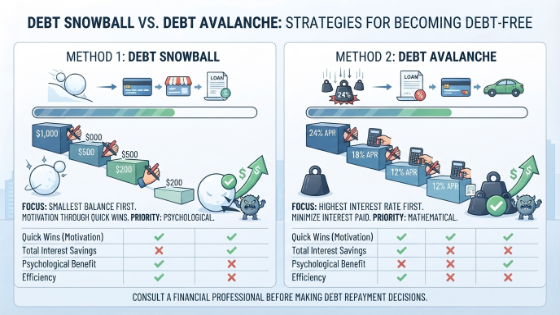
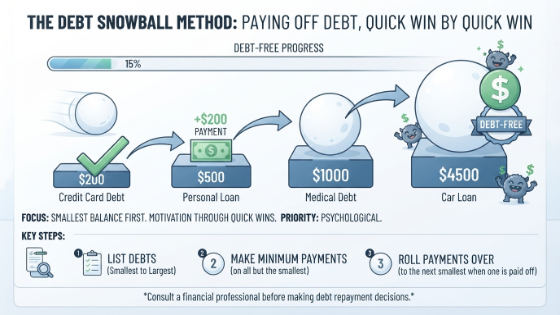
The debt snowball method, popularized by Dave Ramsey, orders your debts from smallest balance to largest, completely ignoring interest rates.
You make minimum payments on everything except the smallest debt, which gets every extra dollar you can throw at it. Once that one’s paid off, you roll its payment into the next-smallest debt, and so on — the payments “snowball” as each debt disappears.
Say you have three debts:
- Credit card A: $800 at 22% APR
- Personal loan: $4,000 at 9% APR
- Credit card B: $2,500 at 24% APR
Under the snowball method, you’d attack Credit Card A first (smallest balance), then Credit Card B, then the personal loan last — regardless of the fact that Credit Card B actually carries the highest interest rate.
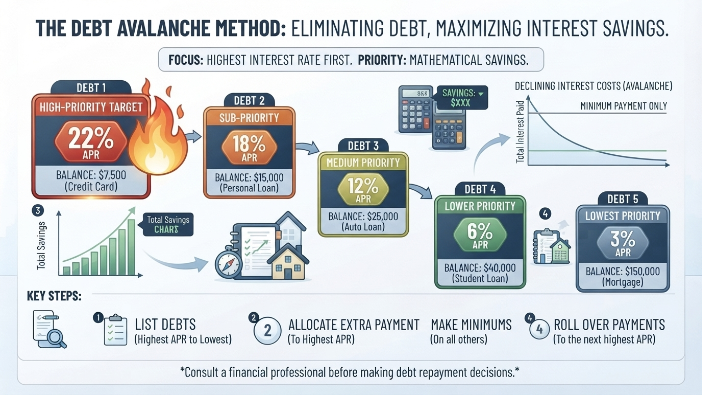
How the Debt Avalanche Works
The debt avalanche method ignores balance size entirely and instead orders debts from highest interest rate to lowest. Using the same three debts above, avalanche would target Credit Card B first (24% APR), then Credit Card A (22%), then the personal loan last (9%) — even though the personal loan has the largest balance.
The logic is straightforward: interest is what makes debt expensive, so eliminating the highest-rate debt first stops the most expensive bleeding as early as possible. Every month that a 24% APR balance sits there costs you more than a 9% balance of the same size, so avalanche prioritizes based on cost rather than psychological wins.
The Actual Dollar Difference
Using the three debts above with an extra $300/month going toward the target debt (on top of minimums), here’s roughly how the two methods compare:
Debt avalanche clears all three debts in about 14 months and costs approximately $520 in total interest.
Debt snowball clears all three debts in a similar timeframe — about 14-15 months — but costs closer to $610 in total interest, because the higher-rate Credit Card B sits untouched longer while smaller, lower-rate Credit Card A gets paid off first.
The gap here is modest — about $90 — because the balances are all relatively small and close in size. The gap grows dramatically with larger, more varied debt loads.
Someone carrying $30,000 across several cards and loans with wider interest rate spreads (say, anywhere from 6% to 27%) can see a difference of $1,500-$3,000 or more in total interest paid, plus a longer overall payoff timeline under snowball.
The core rule of thumb: debt avalanche will always save equal or more money than debt snowball, mathematically, in every scenario. The only question is whether that savings is large enough to matter for your specific situation — and for some people, it’s genuinely small.
Why Snowball Still Wins for a Lot of People
If avalanche is always cheaper, why does snowball remain so popular? Because paying off debt isn’t purely a math problem — it’s a behavior problem, and behavior is where a lot of debt payoff plans quietly fail.
The snowball method is built around a specific psychological mechanism: quick, visible wins. Paying off that first small credit card in month two feels like proof the plan is working, and that feeling of momentum is often what keeps people showing up month after month instead of giving up around month four when motivation naturally dips.
Research on this isn’t just anecdotal — a widely cited study out of Northwestern’s Kellogg School of Management found that people who used the smallest-balance-first approach were more likely to successfully eliminate their debt entirely than those who targeted based on interest rate, even though the interest-rate approach was mathematically superior on paper.
The behavioral payoff of early wins outweighed the extra interest cost for a meaningful share of people.
A Middle-Ground Option
Some people split the difference with what’s sometimes called a “hybrid” approach: knock out one or two very small debts first for an early motivational win, then switch to strict interest-rate order for everything remaining.
This captures some of the psychological benefit of snowball without sacrificing much of the interest savings avalanche provides, especially if the small debts cleared first are genuinely tiny relative to the rest. Also read What is difference between saving and investing.
The Bottom Line
Debt avalanche will save you more money in every case, sometimes by a wide margin, sometimes by an amount barely worth mentioning. Debt snowball trades a bit of that savings for a payoff plan that’s easier for a lot of people to actually stick with to the end.
Neither approach works if you stop paying extra toward debt after a few months — so the real answer to “which is better” is whichever one keeps you consistently making extra payments until the balances hit zero.
If you’re not sure, run both scenarios with your actual numbers (a free debt payoff calculator online takes five minutes) and see how large the gap actually is for your situation before deciding it’s worth optimizing for.
FAQSS
Have you tried to pay off debt before and stalled out?
If motivation has been the recurring failure point, not math, snowball’s quick wins are worth the modest extra interest cost. A plan you actually finish beats a theoretically cheaper plan you abandon in month five.
Are your interest rates wildly different from each other?
If one card sits at 27% and another debt is a 4% auto loan, the avalanche savings become large enough that it’s worth pushing through the slower start. The bigger the rate spread, the more avalanche’s math advantage matters.
Do you consider yourself driven by data rather than encouragement?
Some people are simply more motivated by watching a “total interest saved” number shrink than by watching a debt count go down. If that’s you, avalanche will probably keep you engaged just as well as snowball would for someone else.
Is your debt count relatively small (two or three debts)?
With only a few debts, the difference between the two methods tends to be small in dollar terms, which makes it reasonable to default to whichever method feels more motivating to you personally.