20 Money Saving Challenges That Actually Work
Saving money on willpower alone tends to fail somewhere around week three. Structured challenges work better for a simple reason: they turn a vague goal like “save more” into a specific set of rules with a clear finish line, which makes it much easier to notice when you’re slipping and get back on track.
Below are 20 challenges people actually stick with, organized by how they fit different budgets, personalities, and timelines. Pick one, not all twenty — the biggest predictor of whether a savings challenge works isn’t which one you choose, it’s whether you finish it.
Structured, Fixed-Amount Challenges
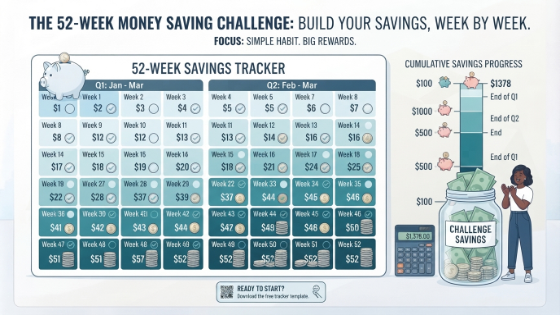
1. The 52-Week Challenge Save an increasing amount each week — $1 in week one, $2 in week two, up to $52 in week fifty-two. Total saved by year’s end: $1,378. Some people reverse it, starting with the highest amount when motivation is fresh and tapering down toward the holidays when money’s tighter.
2. The 100-Envelope Challenge Number 100 envelopes 1 through 100, shuffle them, and each day pull one at random, depositing that dollar amount. Finish all 100 and you’ve saved $5,050 — though the randomness of which envelope you pull on a tight week can make budgeting trickier than the 52-week version.
3. The Penny-a-Day Challenge Save one penny on day one, two pennies on day two, continuing to add a penny each day for a year. It sounds trivial early on, but by December you’re saving over $3 a day, and the total comes to $667.95 — a low-stress entry point for people who’ve never completed a savings challenge before.
4. The Round-Up Challenge Round every purchase up to the nearest dollar (or five dollars, for a faster pace) and move the difference into savings. Many banking apps automate this now, which removes the manual tracking that causes people to quit other challenges.
5. The $5 Bill Challenge Every time a $5 bill lands in your wallet, it goes straight into a savings jar or account instead of being spent. It works because it’s automatic and doesn’t require tracking anything — you either have $5 bills to set aside or you don’t.
No-Spend Challenges
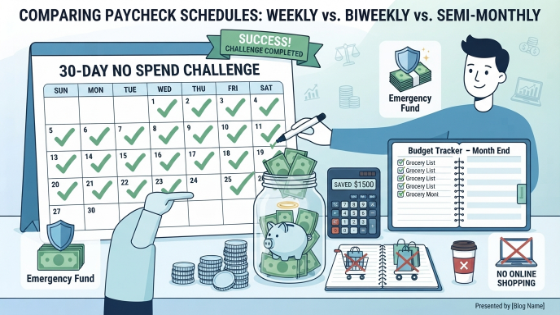
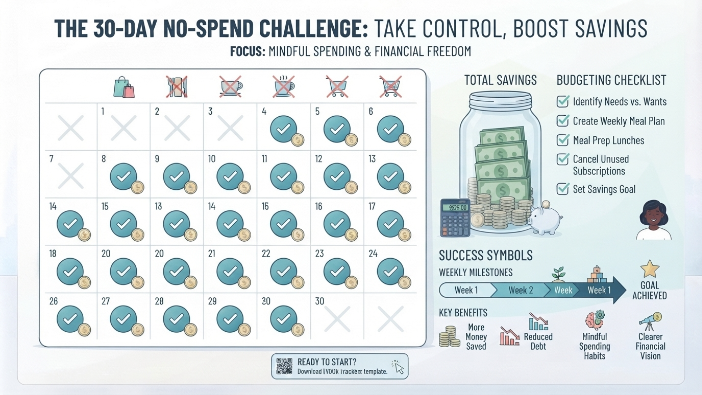
6. The Classic No-Spend Month Cut all non-essential spending for 30 days — no dining out, no impulse purchases, no subscriptions you don’t strictly need. Groceries, rent, utilities, and existing bills still get paid; everything discretionary pauses.
7. The No-Spend Weekend A smaller-scale version for people not ready for a full month. Pick two consecutive days and spend zero dollars beyond what’s already budgeted — a good trial run before committing to something longer.
8. The Category-Specific No-Spend Instead of cutting all spending, target one category completely — no takeout for 30 days, or no new clothes for 60 days. This works especially well if one specific category is quietly draining your budget more than others.
9. The Pantry Challenge Spend a set period — often two to four weeks — eating exclusively from what’s already in your pantry, fridge, and freezer, buying only perishables like milk or produce. It tends to save more than people expect and also clears out food that would otherwise go to waste.
10. The Cash-Only Challenge Withdraw your discretionary budget in cash at the start of the month and leave the cards at home. Once the cash is gone, spending stops — a method that works well for people who spend more freely when a purchase feels abstract, like tapping a card.
Habit-Based Challenges
Money Challenges: Spending Cuts, Income Boosts, and Automation
11. The Subscription Audit
Pull up your last two bank statements and go line by line. Anything you haven’t touched in 60 days gets cancelled — full stop. Streaming services you forgot you signed up for, a gym membership from a January resolution, some app subscription that renewed itself three times before you noticed. Give yourself an hour, not a whole weekend. This one’s boring but it’s usually the fastest money you’ll “find” all month.
12. Meal Planning, 30 Days
The order matters here: plan first, shop second. Most grocery overspending happens because people shop hungry and undecided, then fill the cart with whatever looks good. Sit down once a week, map out your meals, then shop off that list. It’s not glamorous, but it’s one of the more reliable ways to knock down a grocery bill without feeling deprived.
13. Thirty Days, Thirty Things Gone
One item out of your house every day for a month — sold or donated, your call. The selling part puts a little cash in your pocket, sure, but the real shift is psychological. Once you start noticing what you own and don’t use, you get pickier about what comes in the door in the first place.
14. Brown-Bagging It
Pack lunch instead of buying it, every workday, for a set stretch. Do the math on your own numbers: a bought lunch tends to run $10–15, a packed one closer to $3–5. Over 20 workdays that gap adds up faster than most people expect.
15. The 48-Hour Freeze
Before any non-essential purchase over roughly $50, sit on it for two days. That’s it. Most impulse buys lose their pull once the initial spike wears off — this is specifically aimed at impulse spending, not the planned stuff you already know you need.
Boosting Income, Not Just Cutting Spending
16. The Side Hustle Sprint
Pick one specific income activity — reselling, freelance gigs, driving for a rideshare app, whatever fits your schedule — and commit to it for 30 days. The catch: every dollar earned goes straight to savings, not into regular spending. It’s a short enough window to actually finish, and long enough to see if it’s worth continuing.
17. Declutter and Sell, All In
A harder version of #13. Instead of pacing it out over a month, block off a weekend, go room by room, and list everything sellable on a marketplace app in one push. Every dollar from it goes to savings or debt, no exceptions.
18. The Windfall Rule
Decide now, before any windfall shows up, that 100% of unexpected money — tax refunds, gift cash, a bonus — goes straight to savings. The reason this works better than deciding in the moment: in the moment, it almost always gets spent.
Making It Automatic
19. The Percentage Skim
Set an automatic transfer for a fixed percentage of every paycheck — even just 5% — moving to savings the instant it lands, before you’ve had a chance to plan around it.
20. Flip the Budget
Most people pay every bill first and save whatever’s left over, which usually means nothing’s left over.
Flip it: automate your savings transfer for payday, then build the rest of your spending around what remains. It takes the monthly negotiation with yourself out of the equation entirely.
Matching the Challenge to Yourself
Most failed challenges aren’t badly designed — they just don’t fit the person trying them. A few quick filters:
- Never finished one of these before? Start with something automated (round-up transfers, percentage skims), not something that leans on daily willpower.
- Overspending in one specific category? A targeted no-spend beats a sweeping, hard-to-sustain no-spend month.
- Need to see progress to stay motivated? A jar, a printed tracking chart, something physical — that beats a number quietly moving in a banking app.
- Irregular income? Percentage- and windfall-based challenges bend with what actually comes in; fixed weekly amounts don’t.
Don’t stack them. Running a strict no-spend month, a 52-week challenge, and a subscription audit all at once tends to collapse under its own weight within two weeks. Finish one, let it become routine, then layer in the next.