

How to Budget Every Paycheck Like a Financial Expert
Most budgeting advice is built around a monthly calendar that doesn’t match how most people actually get paid.
If you’re paid biweekly, weekly, or on inconsistent freelance timing, a budget designed around neat calendar months tends to fall apart fast — bills come due before the “monthly” budget accounts for the paycheck that’s supposed to cover them.
Budgeting per paycheck instead of per month fixes this mismatch directly. Here’s how to actually set it up, including what changes if you’re paid biweekly versus semi-monthly versus weekly.
Why Paycheck-Based Budgeting Works Better
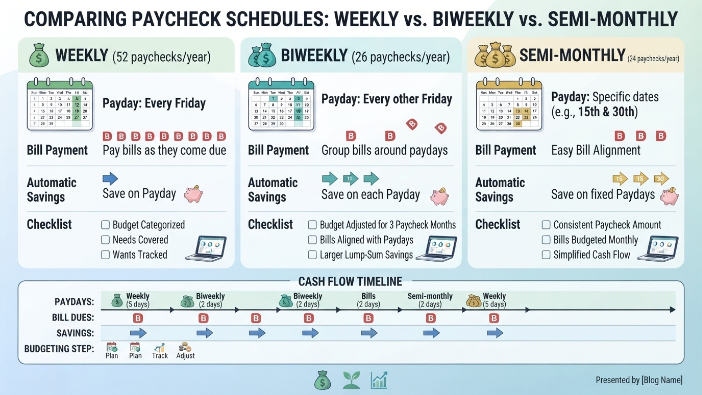
A monthly budget assumes money arrives in one clean lump sum on a predictable date. In reality, most hourly and salaried workers are paid biweekly (every two weeks) or semi-monthly (twice a month, usually the 1st and 15th) — and those two schedules aren’t the same thing, even though they sound similar.
Biweekly pay means 26 paychecks a year, which works out to two months a year with three paychecks instead of two. Semi-monthly pay means exactly 24 paychecks a year, always two per month, but the dates shift slightly depending on weekends and holidays.
Confusing the two is one of the most common budgeting mistakes — assuming a “three paycheck month” under a semi-monthly schedule when it doesn’t actually exist under that system.
Building the budget around each individual paycheck, rather than an assumed monthly total, removes this confusion and matches money to bills based on when it’s actually available.
Step 1: Map Your Paychecks to Your Bills
Before assigning a single dollar, lay out every recurring bill next to the exact date it’s due, then match each bill to the paycheck that arrives before that due date. This is the step most budgets skip, and it’s the one that prevents the classic problem of a bill hitting three days before payday with nothing left to cover it.
A simple way to do this: list every bill down one column, its due date next to it, and then mark which paycheck (by date) needs to cover it. Rent due on the 1st gets covered by whichever paycheck lands closest to but before the 1st — not necessarily the paycheck that happens to land on the 1st itself.
Step 2: Assign Every Paycheck a Job
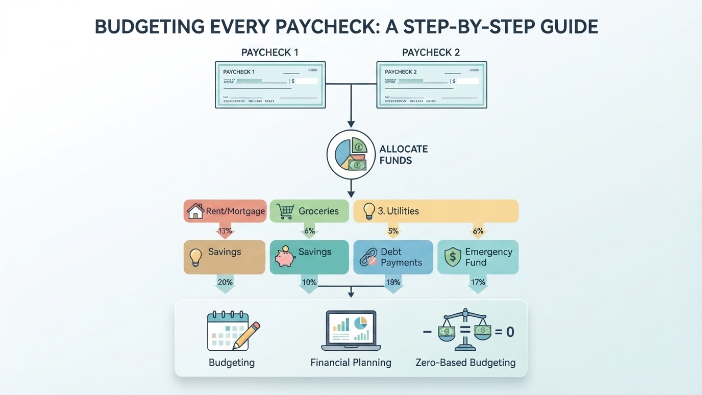
Once bills are mapped to specific paychecks, give every paycheck a complete job before spending any of it — a method often called zero-based budgeting, where income minus all assigned categories equals zero, not because you’re broke, but because every dollar has a destination.
A workable structure for a typical paycheck:
- Fixed bills assigned to this paycheck (rent, insurance, loan payments)
- Variable essentials — a set grocery and gas allowance for the pay period
- Savings transfer — ideally automated the day the paycheck lands, before it’s available to spend on anything else
- Discretionary spending — whatever’s left, intentionally, rather than whatever happens to remain by accident
The order matters. Savings assigned last tends to get skipped when a paycheck feels tight; savings assigned first, immediately on payday, tends to actually happen.
Step 3: Handle the “Extra” Paycheck Months
If you’re paid biweekly, two months a year will bring a third paycheck you’re not expecting if you’ve built your budget around “two paychecks a month.”
Rather than treating that third paycheck as free money to spend, decide in advance what it’s for — a specific savings goal, extra debt payment, or building a small buffer for irregular expenses.
Knowing exactly which months bring the extra paycheck (it’s predictable once you check your calendar for the year) removes the surprise entirely and turns what feels like a windfall into a planned event.
Step 4: Build a Buffer for Irregular Paychecks
For income that isn’t a predictable biweekly or semi-monthly deposit — freelance work, tips, commission, variable hourly shifts — paycheck-based budgeting needs one extra layer: a buffer account that smooths out the unevenness.
The approach: calculate your minimum reliable income based on your lowest realistic pay period over the last six to twelve months, and budget fixed bills against that conservative floor rather than an average.
Anything earned above that floor in a strong pay period goes into the buffer account, which then covers the gap in a weaker pay period rather than forcing bills to compete with each other in real time.
This single habit is usually what separates people with irregular income who budget successfully from those who feel like they’re always catching up — the buffer breaks the direct link between “how much did I make this exact week” and “can I pay this exact bill.”
Step 5: Automate What You Can, Track What You Can’t
A few things worth automating the moment each paycheck lands, rather than relying on remembering to do them manually:
- Savings transfers, moved out before the money is visible in checking
- Fixed bill payments, scheduled against the paycheck that’s mapped to cover them
- A small transfer to the irregular-income buffer, if that applies to you
What still needs manual tracking, at least weekly: variable spending like groceries, gas, and discretionary categories, since these are the ones most likely to drift if left unchecked.
A simple spreadsheet or budgeting app that updates per pay period (rather than a static monthly total) keeps this visible without requiring daily effort.
A Common Mistake to Avoid
The most frequent error in paycheck budgeting is treating each paycheck as an isolated event rather than part of a connected system.
A paycheck that arrives right before rent is due might look “smaller” after rent than a paycheck that doesn’t have to cover rent at all — but comparing the two directly and assuming something’s wrong misses the point.
The comparison that matters is whether the full pay period’s income, mapped against that period’s bills, balances out — not whether one individual paycheck feels bigger or smaller than another.
The Bottom Line
Budgeting by paycheck instead of by month solves a mismatch that trips up a lot of otherwise solid budgets: money doesn’t arrive in one neat monthly lump, so a budget shouldn’t be built as if it does.
Map each bill to the specific paycheck that needs to cover it, give every paycheck a complete job the day it lands, and build a buffer if your income is uneven — and the month-to-month anxiety of “will there be enough before the next payday” mostly disappears, because the plan was never assuming a payday schedule that didn’t match reality in the first place.