30-Day No Spend Challenge: Save Thousands This Year
A no-spend month sounds simple until you actually try to define “spending” — because almost everything, from the coffee on the way to work to the streaming subscription you forgot you had, technically counts.
The challenge works precisely because it forces that reckoning. Done properly for even one month, it tends to reveal exactly where money has been quietly leaking, and repeated a few times a year, it can realistically add up to thousands of dollars in savings.
Here’s how to actually structure 30 days of no spending — rules, exceptions, and what to do with the money once the month is over — rather than a vague resolution that falls apart on day four.
What “No Spend” Actually Means
A no-spend challenge doesn’t mean zero dollars leave your account for 30 days. Rent, utilities, minimum debt payments, groceries, and anything else already essential and already budgeted still happens.
What stops is discretionary spending — the category of purchases that are optional, even if they don’t always feel optional in the moment.
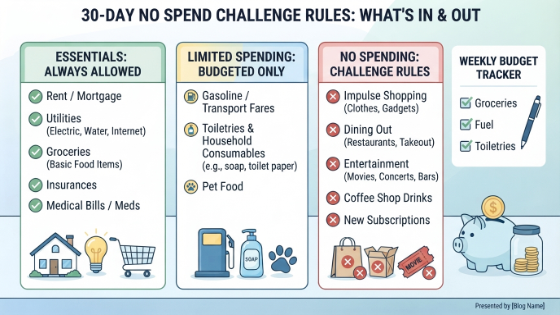
Before day one, it helps to sort spending into three clear buckets:
Non-negotiable essentials — rent or mortgage, utilities, insurance, minimum loan payments, medication. These continue exactly as normal.
Necessary but flexible — groceries, gas, basic toiletries. These continue, but with a tighter, pre-set budget and no upgrades or extras.
Fully discretionary — dining out, entertainment, new clothes, home decor, hobby purchases, impulse buys. These stop completely for the 30 days, no exceptions carved out mid-month.
Writing this list out before starting removes the ambiguity that causes most no-spend months to quietly dissolve by week two, when “just this once” purchases start creeping back in under the justification that they’re somehow essential.
Setting Up Before Day One
A few things worth doing in the day or two before the challenge actually begins:
Stock the pantry strategically. Do one larger grocery trip covering staples for the full month, so a bare fridge doesn’t become the excuse for a takeout order on day twelve.
Cancel or pause what you can. Review subscriptions and pause anything non-essential for the month rather than just resolving not to use it — a paused subscription removes the temptation entirely.
Tell people involved in your social plans. If dining out with friends is a regular habit, let them know in advance so alternatives (a potluck, a walk, a game night at home) can replace it without an awkward explanation each time an invite comes up.
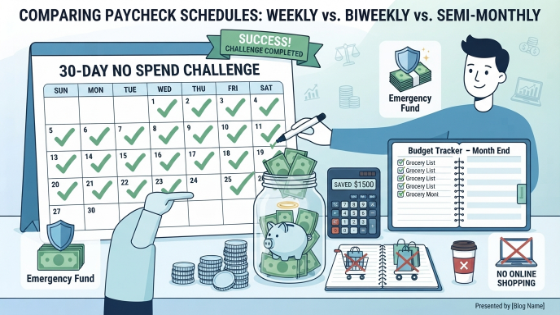
Set up a visible tracker. A simple calendar where each no-spend day gets marked off creates the same kind of visible momentum that makes other savings challenges easier to stick with — seeing 22 consecutive marked days makes day 23 harder to break.
Common Sticking Points and How to Handle Them
Social situations. Dining out with friends is usually the first place a no-spend month breaks down, mainly because it’s tied to relationships, not just spending habits.
Suggesting a free or low-cost alternative — hosting instead of going out, a hike instead of drinks — usually works better than declining outright and disappearing from the plans entirely.
Genuine emergencies. A no-spend challenge isn’t meant to override real needs — a car repair required to get to work, a medical cost, a genuinely necessary replacement for something broken.
The distinction that matters is whether the purchase is solving an actual problem or just responding to a want that feels urgent in the moment; a 48-hour pause before any purchase that feels like a gray area helps sort the two apart.
Boredom spending. A large share of discretionary purchases happen out of boredom rather than genuine need — a scroll through a shopping app becomes a purchase simply because there’s nothing else happening.
Having a specific list of free replacement activities ready in advance (a library book, a walk, a show already paid for) removes the moment of decision-making that usually ends in a purchase.
Special occasions mid-month. Birthdays and events don’t pause for a no-spend month. Rather than breaking the challenge for them, it’s usually easier to either budget a small, pre-planned exception for that specific occasion in advance, or shift the challenge dates so it doesn’t overlap a month with unavoidable spending obligations.
What the Money Actually Adds Up To
The exact savings depend entirely on someone’s normal discretionary spending, but a rough national picture: many households spend somewhere between $200 and $500 a month on dining out, entertainment, and impulse purchases combined, before counting subscriptions or unplanned retail spending.
Cutting that out entirely for a month, plus pausing two or three unused subscriptions at $10-20 each, commonly adds up to $250-$600 saved in a single 30-day stretch for a fairly typical household — and considerably more for households with heavier discretionary spending habits going in.
Run the challenge three or four times across a year — say, one month per quarter — rather than attempting a permanently no-spend lifestyle, and the annual total for a lot of households lands somewhere in the $1,000-$2,000+ range, without requiring any change to income or a full-time frugal lifestyle the rest of the year. Also read 20 Money Saving Challenges That Actually Work.
What to Do With the Money Afterward
The challenge only compounds into something meaningful if the money saved actually goes somewhere specific rather than quietly folding back into regular spending the moment the 30 days end. A few options worth deciding on before the month starts, not after:
- Route it directly into an emergency fund if that buffer doesn’t already exist at a comfortable level.
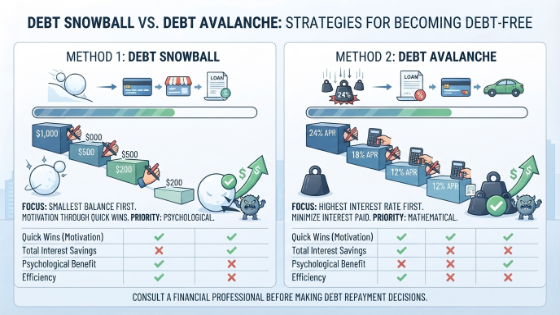
- Apply it as an extra payment toward the highest-interest debt, where it does the most good.
- Move it into a separate savings goal — a trip, a large purchase, a house down payment — so the win from the challenge stays visible rather than disappearing back into a general checking balance.
After the 30 Days
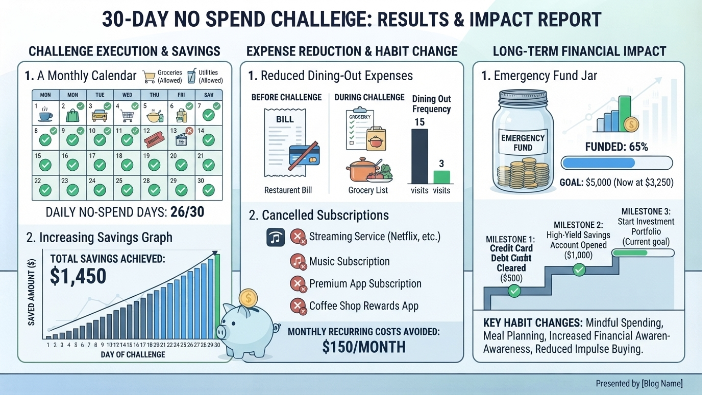
The transition out of a no-spend month matters as much as the month itself. Jumping straight back into unrestricted spending on day 31 tends to trigger a rebound — a burst of “catch-up” purchases that can undo a meaningful chunk of what was just saved.
A gentler landing works better: reintroduce discretionary spending gradually, with a modest budget for the first week or two back to normal, rather than removing all restrictions at once.
Some people find the month reveals habits worth keeping permanently — a subscription that turns out not to be missed at all, or a pattern of impulse spending that becomes much easier to notice once it’s been interrupted for 30 straight days.
Treating the challenge as a one-time reset rather than a diagnostic tool wastes some of its value; the real payoff often isn’t just the money saved during the month itself, but the spending patterns it exposes for the months that follow.